Case study · Professional experience
Foreign trade,connected and clear.
Full-stack development and front-end leadership on a platform to manage imports, exports and foreign trade operations.
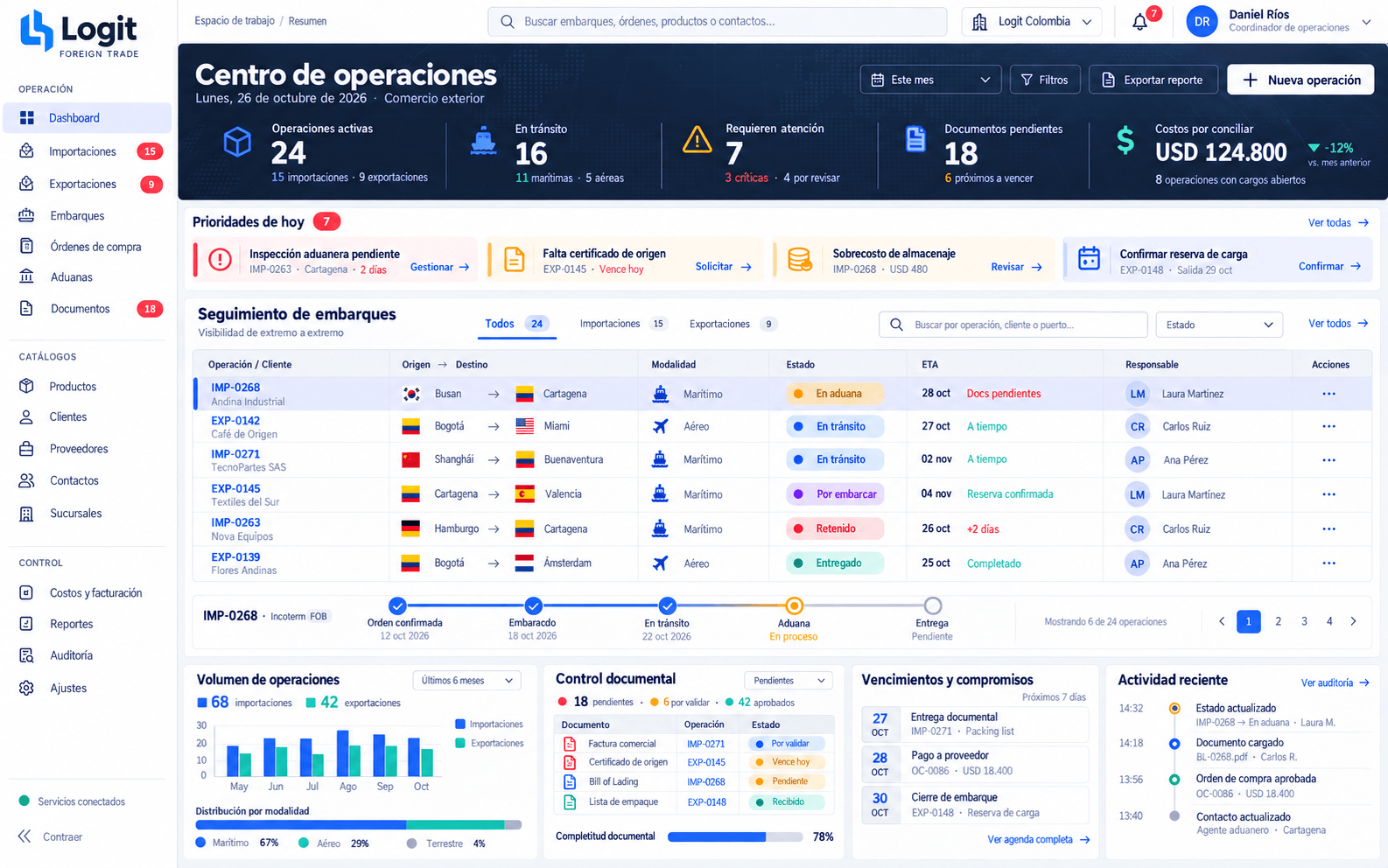
Illustrative interface · Fictional data
- Order confirmedOct 12, 2026
- ShippedOct 18, 2026
- In transitOct 22, 2026
- CustomsIn progress
- DeliveryPending
- My role
- Full-stack · Front-end leadership
- Technologies
- Angular · .NET · TypeScript · C#
- Context
- B2B foreign trade
- Scope
- Interface, services and quality
Company product. This case describes my participation and contributions.
01 / The context
Many operations.One coherent experience.
The platform brings together foreign trade processes and related catalogs. The challenge was to turn that complexity into clear interfaces and a maintainable development base.
Imports and exports
Operations management, shipment tracking and customs processes.
Purchase orders
Creation, tracking and control of orders tied to each operation.
Products and catalogs
Management of products, categories and catalogs linked to foreign trade.
Customers and suppliers
Registration and administration of customers, suppliers and their key data.
Contacts and branches
Management of contacts and branches across different locations.
Settings and permissions
System configuration, parameters and role and permission management.
02 / My participation
From development toteam decisions.
01
Front-end leadership
Interface architecture, conventions, code reviews and support for the team.
02Full-stack development
Angular interfaces and contributions to .NET services.
03Shared design system
Co-creation of reusable components, variables and patterns.
04Business flows
Forms, catalogs and connected operations.
03 / Technical decisions
A foundation built togrow with the product.
Complexity is also solved in the architecture, consistency and the team’s work.
- 01
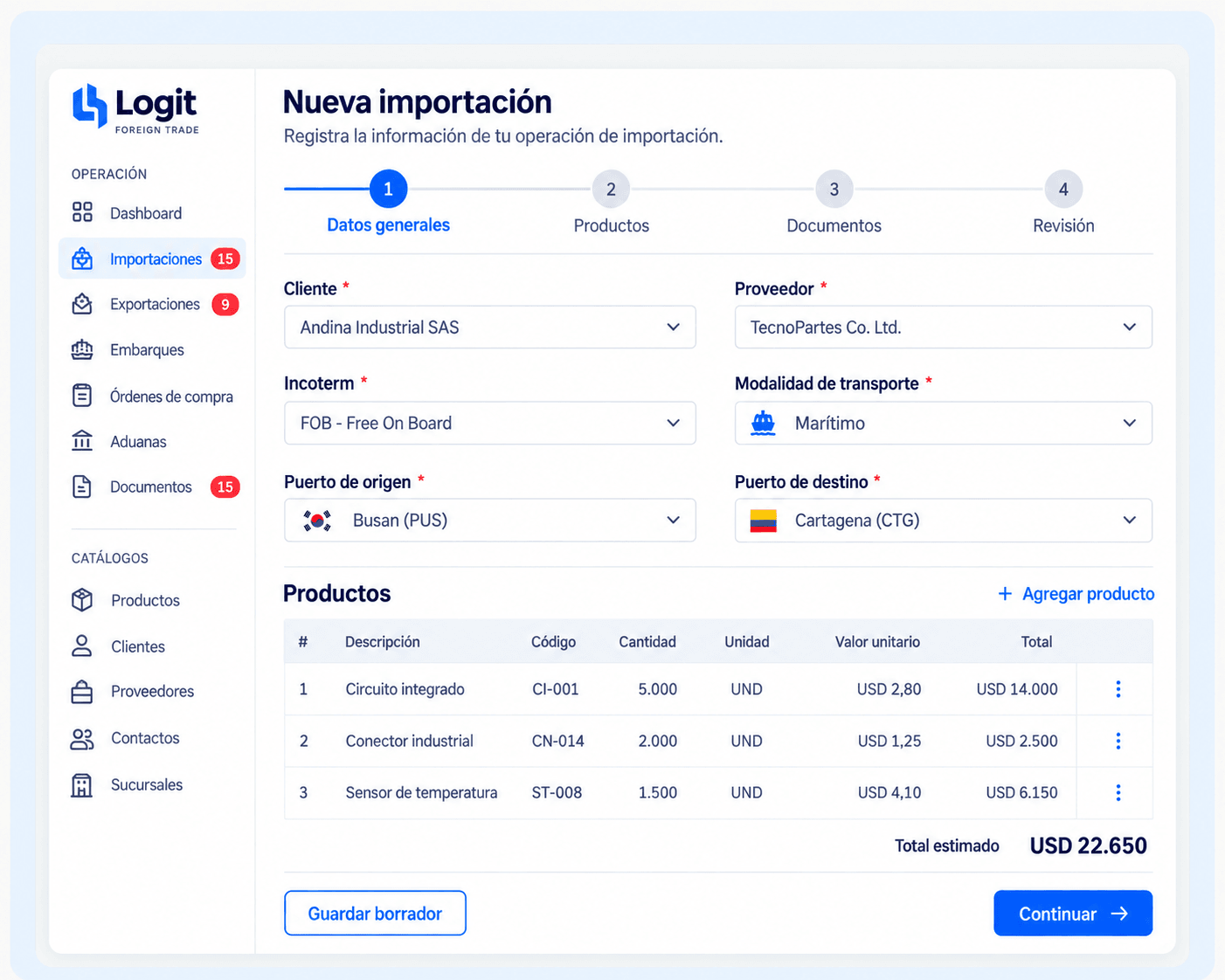
Reactive forms and flows.
Validation, catalog loading, filters, pagination and shared CRUD patterns.
I designed and led the implementation of reactive forms in Angular, with real-time validation, dynamic catalog loading, filters and pagination. We established reusable patterns for the platform’s main flows, keeping a consistent experience aligned with the design system.
- 02
Modular architecture.
Components, services and conventions to keep a consistent base.
I co-created the front-end architecture with Angular, defining modules, components, services and code conventions. This structure made teamwork easier, enabled feature reuse and let the product evolve across multiple fronts.
Access and permissions
Authentication and granular role and permission checks, aligned with the platform’s different profiles.
Internationalization
Shared translations and criteria for a multilingual interface, considering multiple locales, date, currency and unit formats.
Audit and traceability
Action logging and support for error diagnosis, with structured and observable information in key modules.
Backend contributions
.NET services, Entity Framework and Clean Architecture, DDD and CQRS patterns, collaborating on business logic and validation.
Design system
- Tokens
- SCSS
- Components
- Layouts
- Consistency
I co-created a design system with centralized variables, reusable components and usage guidelines to keep the experience consistent across the platform.
How I worked
Technical judgment, collaborationand continuous improvement.
- 01
Understand the flow
Turn business needs into clear interactions.
- 02
Build as a team
Implement, review and share decisions.
- 03
Care for quality
Validate behavior and keep traceability.
AI tools as development support, together with technical review and my own judgment.
04 / Learnings
What this experienceadded to how I build.
Think in systems, not just screens.
Understand the platform’s full context, its users and its dependencies.
Make team decisions explicit.
Document criteria, agree on conventions and make collaboration easier.
Connect design, business and maintainability.
Look for solutions that balance user experience, business goals and a sustainable technical base.
This experience strengthened my ability to take responsibility for the interface and collaborate on a complex business platform.
Next projectBosvia →